US Expands Iran Strikes: Stunning, Best Update


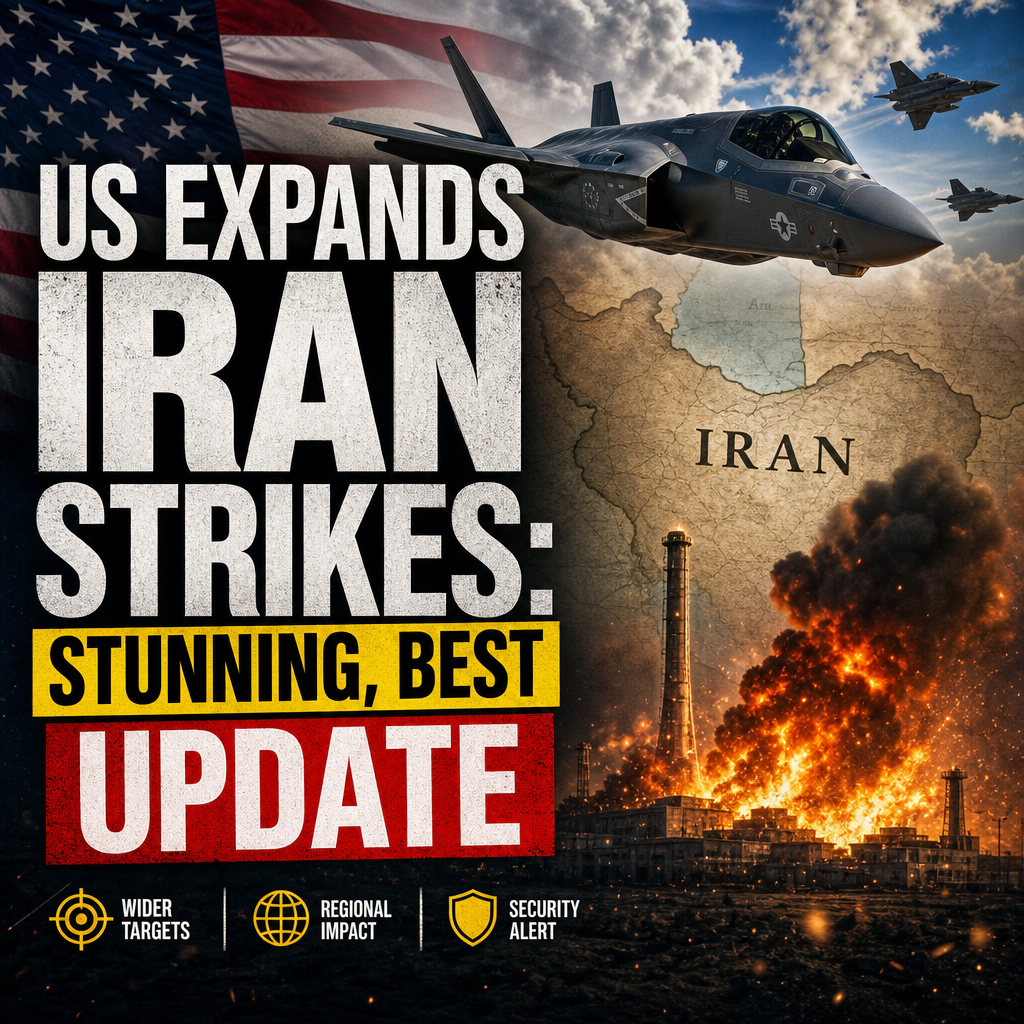
US expands Iran strikes, and the latest reports suggest the confrontation is moving beyond a narrow military exchange into a wider contest over strategy, deterrence, and regional stability. What stands out across the coverage is not just the scale of the violence, but the competing explanations for why it is happening and what it could trigger next.
The broad picture from the reports is stark: Washington is being described as widening its military actions while Iranian-linked channels and officials frame the strikes as proof of foreign aggression. At the same time, analysts and local accounts point to the practical consequences on the ground — disrupted coastal activity, heightened risk near sensitive facilities, and growing uncertainty for civilians who live far from the centers of decision-making.



US expands Iran strikes: what the different reports agree on
Across the coverage, one point is consistent: the situation is escalating rather than settling. Al Jazeera’s reporting highlights claims that attacks have reached areas near a nuclear site, with damage or pressure extending to fishing piers and other civilian-linked infrastructure. That detail matters because it suggests the conflict is no longer limited to military installations alone. Even when a strike is framed as precision pressure, the spillover can affect livelihoods, transport, and confidence in local security.
RT’s framing, by contrast, tends to emphasize the geopolitical confrontation and the possibility that Washington’s actions are part of a broader campaign rather than a one-off response. That lens reflects a familiar Russian media skepticism toward US military intervention: the idea that the United States presents its actions as defensive, while opponents see them as escalatory and destabilizing.




Sky News, meanwhile, is more likely to situate the story in the language of international security and immediate risk. Its coverage generally places emphasis on the possibility of retaliation, the danger to regional shipping routes and energy markets, and the political pressure on Western governments to explain why the crisis is deepening. That is a different emphasis, but not an incompatible one. Together, the reports sketch a picture in which each side is trying to control the narrative as much as the battlefield.
Why the nuclear dimension makes everything more dangerous
Any attack near a nuclear facility raises the stakes sharply, even when officials insist the target was something else nearby. The reason is obvious: once the public hears “nuclear site” and “strikes” in the same sentence, fears of contamination, sabotage, or miscalculation rise immediately. Even a limited strike can be read as a step toward a much broader confrontation.
That is why the reports’ references to fishing piers and coastal facilities are more significant than they may first appear. Civilian infrastructure often becomes the first visible casualty of a military campaign that starts with strategic targets but quickly affects ordinary life. Local workers lose income, ports slow down, and communities begin preparing for shortages or further attacks. In conflicts like this, the line between military pressure and economic punishment can become blurry.
There is also a communications battle underway. Iran is likely to present the strikes as proof that its enemies are willing to endanger civilians and critical infrastructure, while US officials will argue that any action is aimed at stopping a larger threat. Both narratives may contain elements of truth, but neither fully captures the human cost. The people most affected are rarely the ones shaping the policy.
The competing narratives are part of the conflict
The reported expansion of strikes is not only a military event; it is a test of public messaging.
– The US-aligned view: pressure is necessary to deter further threats and protect regional and international security.
– The Iranian view: outside powers are escalating a dangerous confrontation and targeting the country under the guise of defense.
– The skeptical international view: whatever the stated justification, the risk of broader war is growing, and the burden falls on civilians and neighboring states.
This clash of interpretations helps explain why the story remains so volatile. A single incident can be described as retaliation, self-defense, provocation, or preemption depending on who is speaking. That makes it hard to separate verified facts from strategic claims in real time. In a fast-moving conflict, certainty is often the first casualty.
What remains unclear
Despite the strong language in the reporting, some important questions remain unresolved. The exact scale of the latest strikes, the full extent of damage near the reported nuclear-linked sites, and the likelihood of immediate retaliation are still uncertain. That uncertainty is not a weakness in the coverage; it is a feature of the situation itself. Conflicting accounts often emerge before investigators, satellite analysts, or independent observers can confirm what happened.
What can be said with confidence is that the window for de-escalation appears to be narrowing. If strikes are indeed reaching areas close to nuclear infrastructure and civilian facilities, the margin for error is shrinking fast. Even if leaders believe they can control the pace of events, military exchanges have a habit of creating their own momentum.
For now, the most reasonable conclusion is cautious rather than dramatic. The reports point to a conflict that is deepening, but not yet fully predictable. The US may view the expanded strikes as leverage; Iran may see them as an act of aggression; regional observers may see them as a warning that a wider crisis is becoming harder to avoid. All three readings can be true at once.
The danger is that each side may believe it is sending a limited message, while the other hears the beginning of something far more serious. That is how regional crises often worsen: not through one overwhelming blow, but through a series of moves that are individually defensible and collectively disastrous.